








Date Published: November 2026
The Industrial and Innovative Design Student Toolbox
This story is part of Cedarville Magazine’s fall 2026 issue: Where Beauty Begins.
Did you know that Cedarville offers the only evangelical industrial design program in the nation? After two years on Cedarville University's campus, industrial design students spend two years in Columbus at the International Center for Creativity, learning to design products and services that solve real-world problems. Graduates have designed products for Chick-fil-A, Bose, New Balance, Bath and Body Works, and other major companies. In this interview, Cedarville Magazine sat down with Gabe Pyle ’12, program director and instructor, to give you an insider's perspective on the program.
So what IS industrial design? I’m not sure that’s a field our readers are familiar with.
I'm glad you asked that, because so many people are unaware that this is a discipline. People assume that it has something to do with designing factories, which is totally understandable. That's what the name might suggest.
What I try to tell people is that industrial design is the design of things that are mass manufactured. The things that you see at Target — the pots, pans, cups, pillows — outside of maybe the clothing, everything there was industrial-designed. Someone had to make decisions for what those things were going to look like, how they would be assembled, and what materials they would be made of to meet the goals of the company and the customer.
What skills go into being an industrial designer?
One is the technical skills: being able to draw in perspective well, being able to make a mark on a page, understanding how CAD works. These are all things where there are correct and incorrect answers.
Then we also have design: the sense of what looks good. So understanding how line and form and color and tension all affect the way something looks. I also group the psychology of design here.
But there's a third category, and that's creativity. I group things like thinking outside the box, the design thinking process, identifying user needs, and empathy into creativity.
What is design thinking? Can you give us an example of what that looks like?
Design thinking allows designers to ask questions and gives them a rough structure for how they can go about solving the problem. It's really like a toolbox, where depending on the situation, you may use one tool over the other. But the design thinking toolbox says, “Here are the ways that you can go about asking better questions, identifying the emotional drivers of your users, testing out ideas to see if it's going to meet their needs and produce something that is going to solve their problem.”
One tool in the design thing toolbox is asking why five times, the “five whys.” Sometimes, they will get you to a root problem. Sometimes, if you keep asking why, you'll end up getting back to the root cause of all problems: the issue of sin. What we teach our students is that you want to find some leverage point between “I need to design a better phone case” and “man has fallen because we ate of the fruit.” Somewhere in that chain, there's a good leverage point for us to be able to make human lives better.
How do you cultivate the design thinking mindset in the classroom?
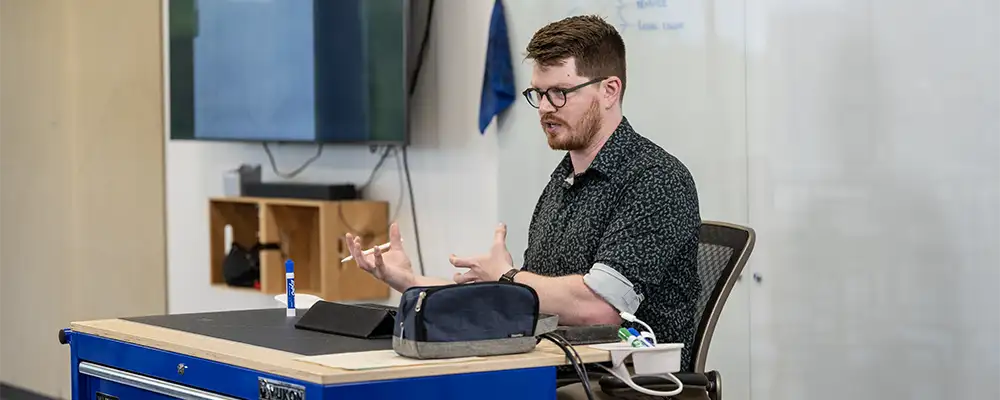
We're fortunate to be able to spend a lot of time with the students during their two years here. We see how they think, how they go about working on whatever they're working on, and we can tailor our advice for how they can grow their skills based on what we see.
We have some students who come from the engineering side of things and think more linearly but are excellent at making something that can work. And we also have students who come from the art side and have a high creativity factor but struggle with feeling restricted by processes. And then we have students from the business side who say, “I want to make things that change people's lives, that make money, that can influence the world.”
We as instructors get to work with all three of those mindsets, trying to encourage the natural inclinations that those students have while also challenging them to shore up where they might be weak. For the engineering students, try to get them to think more creatively, think outside of the box. For the artistic students, try to get them to work with a process so they can produce more consistently. For the business students, try to get them to visually communicate so that they can realize these big ideas on paper. Those are the things that we're doing in the classroom.
Does your shared faith affect the way you teach your students?
I get to see them first as made in the image of God. And while not making assumptions, I also get to treat them as brothers and sisters in Christ, knowing that ultimately the reason that we do any of these things is because we have been given gifts that we get to share. I get to unabashedly share what I think the truth is and pray with them, and we get to walk them through disassembling the mindset that their skill is their value. Their value is that they are made in the image of God — that God said they're valuable.
How does your own faith (and your students’ faith) ground the way you practice design?
When God was telling the story of how He created the world, that's the word He used first: Creator. And we get to share in that same spirit of creativity. We also get to use it as a model and say, “How can we make something that we can look at and say, ‘I've done good work?’” There's something beautiful — holy, even — about looking at your work and saying it's good.
We see the same elements of that story in Scripture again and again. There's chaos; God brings order to the chaos. It’s similar in the story of Noah. God brought order and safety out of the chaos of the flood. In the wilderness, where there is nothing but chaos, God set up the tabernacle and said, “You can meet Me here. I am your refuge in this.” And then, of course, Jesus calming the storm.
We live in a world where chaos is the natural state. But we get to look at the world and say, “From this chaos, we're going to do what we can to bring a little bit of the order back.”
How do you go about bringing that order? What kinds of problems do you solve?
Many of the problems our students try to design for are “wicked problems.” Wicked problems are problems that often have seemingly contradictory sets of solutions. There's no silver bullet to solve the wicked problem.
The reason that we teach students about wicked problems is to help them understand that to almost every problem, there's going to be more than one solution. And it gets complex, especially as you're trying to make decisions for large groups of people. So that's where you go back to asking why five times. Eventually, you get to the fact that we live in a fallen world, and no system is as good as we want to make it. But somewhere along the line, you can see, “Oh, here's something that we, as creators, as changers of systems, can do.”
Is that a motivator you see many of your students come in with? Why do your students choose industrial design?
I've had grads who are interested in design because that's their particular skillset — drawing, style, creativity — but they care about helping other people. We've had a couple of capstones that were working to make medical equipment easier to use. We also have students who have gone into missions because that's where God called them or what they saw as the natural expression of their skillset. So we see students who are interested in the servant-heartedness, in making the world better. We've had almost 300 grads, and they're all over the world making a positive impact.
We also get students who want to make cool things, and there's nothing wrong with that. Right now, we're living in the "already not yet," so things are still broken, and we get to do what we can to try to put some Band Aids on things in a way where things look beautiful. But that's the kind of stuff that, in the New Kingdom, we are not going to need. There's also value in making things that bring joy. We will continue to make cool things in the new creation, even when we don't have to solve problems anymore.
When you picture your students walking across the graduation stage, what are the most important things you hope they'll come away from the program with?
Empathy is one of them. Understanding that the right solution is right for the person who is experiencing the problem. You're designing for them, so you have to put yourself in their shoes. Empathy is one of those things that I think just makes people more well-rounded. It makes them curious and better with interpersonal skills. So that's one of the most important things I teach them.
A design thinking principle is being a T-shaped person: being very good at your craft, going deep vertically, but then also stretching out so that you can relate to other disciplines. I want them to be T-shaped people so that they're really good at what we teach them but also maintain their interests so that they can have interesting conversations with people. It also helps with interviews.
But honestly, one of most salient things that we teach them is how to be a better person overall. We can teach them skills. We can teach them how to be designers. We can teach them how to be more creative, but so can a lot of things you can read or watch online. What we get to do is help them understand how to do that while being rooted in biblical truth, caring for other people, and maintaining their curiosity. We get to let them continue to nurture their souls.