







Date Published: November 2026
Inside Cedarville's 220 Gallery
This story is part of Cedarville Magazine’s fall 2026 issue: Where Beauty Begins.
Three vases twist in the pattern of breath leaving the lungs. A general’s head is driven through with a tent peg, sculpted in hard gray stone resting on a soft white porcelain pillow. Alongside vibrant spirals, emotive portraits, and digital designs stands a cardboard cowboy boot filled with paper ramen noodles. Stepping into the 220 Gallery on the upper level of the Stevens Student Center at Cedarville University offers a window into the innovative minds of the many art and design students on campus.
But beyond a rotating display of carefully curated artworks, is there a deeper purpose that this gallery serves? On a campus passionate about bringing glory to God in all we say and do, how might the display of a cardboard cowboy boot or an abstract oil painting aid in the furtherance of the Gospel?
CULTIVATED BY FAITH
Visuals have long played a significant role in the Church. “There are several times in the Bible where God calls on craftsmen to create goods for His glorification,” said senior industrial design major Ruby Nelson, whose work has been featured in the 220 Gallery three times, “like the craftsmen who built the temple, the Ark of the Covenant, and David, who wrote the Psalms.” Modern examples of explicitly faith-based art and design include Jago’s vibrant illustrations in the Jesus Storybook Bible, the decorations in a church sanctuary, and even the technology and design behind a missionary’s PowerPoint presentation.
But praise through visuals is not just limited to how it can be used directly by the Church. “When a work is created in an excellent way, it glorifies God,” said Cam Davis, Associate Professor of Visual Communication Design. “That could apply to an excellent logo design, a portrait in oil paint, or an abstract image.”
As the faculty in the visual arts programs challenge their students to develop practical skills, they also encourage them to recognize and pursue excellence in the areas where God has gifted them. “None of the craftsmen in the Bible had the skills to create those things when they started their craft,” said Nelson. “Their skill was refined. And as a student, I see myself as being in that refining stage, preparing for however God will use the gifts He has entrusted me with stewarding.”
FROM HALLWAYS TO FRONT AND CENTER
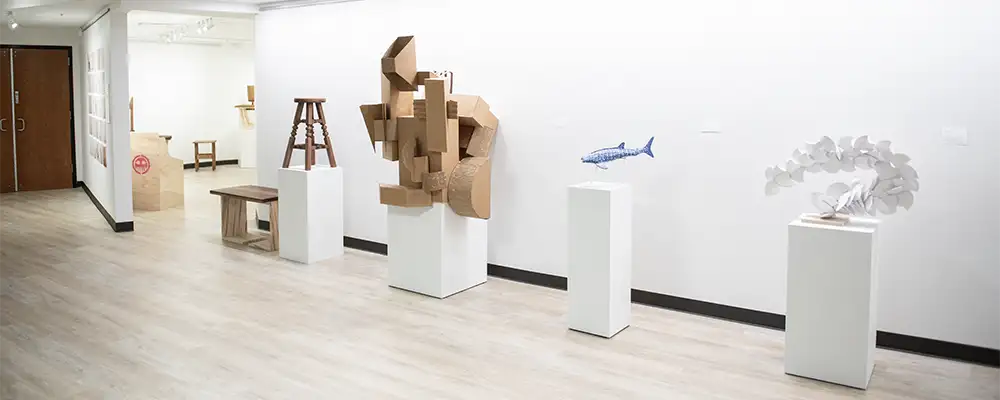
Prior to the establishment of the 220 Gallery in 2021, students of the art and design programs at Cedarville relied on campus hallways and library spaces for temporary exhibitions. Art exhibitions introduce budding professional artists to the process of strategically presenting their work in a way that will engage viewers and invite discourse about both the art and the artist. But the spatial limitations and obscurity of these temporary setups stifled Cedarville students’ opportunities to apply these skills and make these connections. And as the University’s art and design programs continued to grow, the University saw an opportunity to support students' creative work by displaying their art in a more professional setting.
“An exhibition space [provides] the opportunity for all audiences — students, faculty, staff, and visitors — to engage in excellent art and innovative design that uniquely reflect the way we humans were created in God's likeness as image-bearers," said Aaron Huffman, Associate Professor of Graphic Design.
With collaboration and support from multiple areas of campus, the DeVries Theatre in the upper Stevens Student Center was selected as the location for the new gallery. Situated front and center in one of the busiest buildings on campus, the gallery is passed daily by a regular stream of foot traffic — a far cry from exhibitions tucked into less accessible hallways.
In September of 2021, Wakes and Shadows, a solo exhibition by Caleb Booth, Assistant Professor of Studio Art, marked the opening of the 220 Gallery as the new stand-alone space for future art exhibitions at Cedarville University.
Booth’s paintings explored the relationship between the tangible, material world and the intangible force of life behind it. “We are more than flesh and bone, blood and skin,” Booth wrote in an Instagram post announcing the exhibition. “We are also soul and spirit, conscience and emotions. My work allows me to wrestle with these realities in a meaningful way, participating in and magnifying the glory of God.”
ROTATING DISPLAYS, NEVER-CHANGING MESSAGE
Since its opening, the 220 Gallery has been used every year by senior studio art and graphic design majors for their capstone exhibitions and receptions, publicly displaying their best works from their time in their programs and networking with other established artists in their fields. Students across campus are also welcome to submit their art for the juried student exhibition held in the gallery every spring.
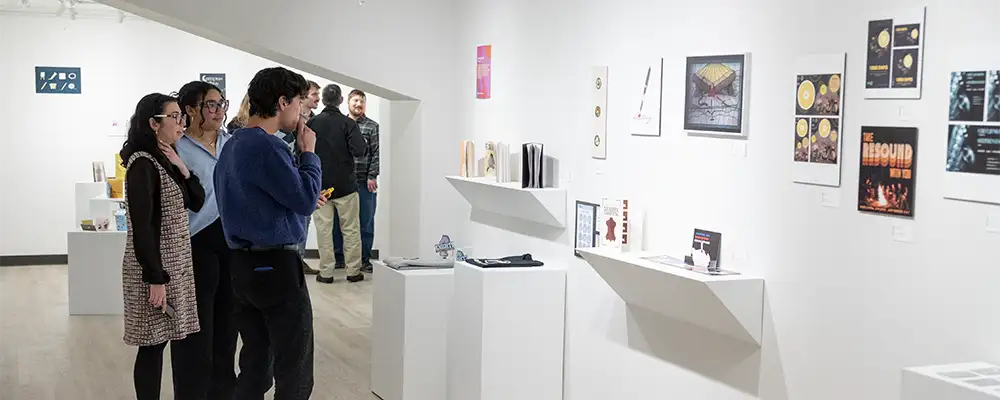
While the primary goal of the space is for student art exhibitions, the 220 Gallery also hosts several guest contributors, including University alumni, local artists, and artists from other universities. “These visiting artists enrich our students’ educational experience by exposing them to a broader range of contemporary artistic practices while also serving the wider Cedarville community through diverse and engaging exhibitions,” said Cat Mailloux, Assistant Professor of Studio Art. Notable artists such as Yellow Springs ceramicist Bruce Grimes and retired Cedarville studio art instructor Jim Mellick have displayed their work within its walls. The fall 2026 exhibition will also be intentionally dedicated to professional artists beyond Cedarville.
“Art has a way of connecting people and their experiences, and that is something that is incredibly important, especially for current young generations,” said Nelson. “I am very grateful that the 220 Gallery gives us a place to share our work.”
SEEDS TRANSFORMED
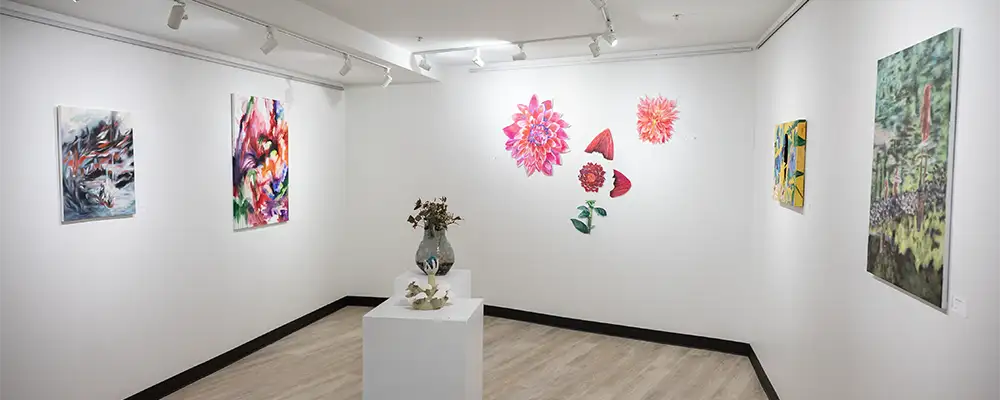
Three vases, a general’s head, and cardboard cowboy boot ramen. These pieces come together alongside a host of other student works in a variety of mediums in the most recent exhibition in the gallery, Seeds Transformed, to reflect one overarching theme: the seeds of creativity transformed to bring praise to our Creator.
“Creativity is planted deep within the soil of mankind,” the sign at the entrance to the gallery reads. “As children and image-bearers of the Creator, we carry the seeds of that inheritance — entrusted to cultivate, to tend, and to bring forth new growth.”
Just inside the gallery doors, senior studio art student Kat Zednik’s Breath Between Crosses uses the color, profile, and shape of three ceramic vases to whisper the story of the thieves who flanked Christ on the cross and the moment Jesus spoke redemption to the one who cried out to Him in his last moments.
Around the corner, senior industrial design student Ruby Nelson’s digital works span from a fan design displaying the growth of her skills as a designer to Redlining, her stream-of-consciousness piece depicting the relationship between perfectionism and the rise of artificial intelligence.
“AI appears more human than any machine in history,” Nelson said. “In Redlining, the girl's face is painted up like a machine, and the machine is wearing a human skull. Because of things like social media, a lot of us only ever see the best parts of one another. To hold ourselves to that standard of perfection is wholly unrealistic, something only a machine could do.” The concept is deeply rooted in biblical truth. Though a machine may be able to generate art and even imitate the appearance of perfect life, it can never possess the intrinsic uniqueness of a living being created in the image of God — a uniqueness that should be embraced rather than stifled in the name of perceived perfection.
Only a few feet away from Nelson’s emotive piece, fellow industrial design senior Kat Hellman’s visual depictions of chronic pain in To Feel and How Living Surviving Feels invite viewers to feel the world as she does. “I nearly constantly experience some sort of pain in my hands, which can make doing some of the things I love difficult at times,” said Hellman. Through bold colors, starbursts, and spiked lines of acrylic paint on canvas, Hellman’s work welcomes discourse on approaching the struggles of our fellow image-bearers with compassion and empathy, bringing hope to those who may walk a similar path to hers.
“I wasn’t expecting these paintings to actually be chosen for the gallery,” Hellman said. “It gives so many opportunities for people to see them and even possibly feel seen by them. Art is a way to connect with people, and I am honored to be able to partake.”
It’s her faith, Hellman says, that leads to the authenticity in the art she creates. “It has led to me being a version of myself that loves people wholeheartedly and seeks to perform in the best way I possibly can.”
It’s her faith, Hellman says, that leads to the authenticity in the art she creates. “It has led to me being a version of myself that loves people wholeheartedly and seeks to perform in the best way I possibly can.”
Venturing further into the gallery, the work of other student artists, from seniors to freshmen, studio art majors to accounting majors, continues to echo this creativity instilled in us by a visionary God from the very first breaths of mankind.
“All artwork reflects the worldview from which it is made,” said Mailloux. “As Christians, our students create work that directly and indirectly reflects what they believe about God, humanity, purpose, and the authority of Scripture. Sometimes that emerges through explicitly Christian or biblical imagery; other times through formal concerns, personal subject matter, or the ways they approach creating itself."
Return to Fall 2026 Articles