








by Rachel Ward, Student Public Relations Writer
Traumatic neck injuries can become fatal within minutes, leaving medics with little time to transport a patient to a hospital. To help slow the life-threatening bleeding, researchers from Cedarville University have developed a lightweight device designed to stop blood flow in the carotid artery without restricting other parts of the neck.
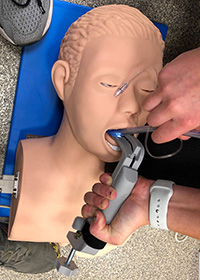 Last month, the U.S. Food and Drug Administration (FDA) approved the Arterial Restriction Clamp (ARC),clearing the way for ARC Trauma — based in Jamestown, Ohio — to begin manufacturing and distributing the device for combat care.
“The idea is that you can reduce blood flow and then work on someone else, especially when there could be a lot of casualties,” said Dr. Tim Norman, distinguished professor of mechanical and biomedical engineering.
ARC device helps medics control traumatic neck bleeding
Previously, combat medics’ only option was using a hand to stop arterial bleeding, but they need equipment that enables them to move quickly to keep multiple soldiers stable at once. The ARC is designed to meet that need by reducing blood flow while freeing medics to care for other patients.
Some combat medics carry packs weighing more than 120 pounds, so combining functions into one device lessens the weight, allowing for quicker care to the injured. In addition to controlling severe bleeding in the neck, the ARC can be used as a tourniquet compression device to stop severe bleeding in other areas of the body.
“They only have so much they can carry,” said Norman. “You want it to be multifunctional and lightweight. That’s why it has these dual functions — occluding the neck and other limbs while also being a laryngoscope.”
L-ARC expands emergency airway and trauma care options
A second version of the device, the L-ARC, was later designed to include a laryngoscope, a tool used to help medical providers secure a patient’s airway and deliver oxygen. Because the neck is a vulnerable, often exposed area, traumatic neck injuries are not limited to combat settings. They can also happen in situations such as car accidents and hockey accidents, as in the case of Adam Johnson from the Nottingham Panthers in 2023.“There have been several instances where a hockey skate has slashed a player’s neck, and it bleeds out fast,” said Norman. “Someone with this device could apply it and stop the blood flow.” Cedarville researchers developed the ARC trauma device
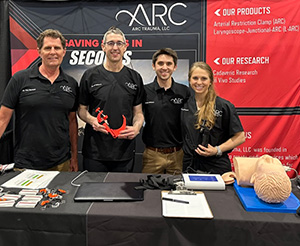 The device originated from a senior project by Lauren Edmonson, a 2019 Cedarville graduate with a degree in allied health. Norman directed Edmonson and her team as they designed and tested the device. In 2019, ARC Trauma, LLC was founded by Norman, Edmonson and fellow team members Austin Ballentine and Caleb Williams. Dr. Jeff Williams, a surgeon, later joined as a research clinician.
FDA-cleared device moves from development to distribution
Although ARC and L-ARC generated interest at medical conferences, FDA testing delayed production and distribution.
Now that the device has received FDA approval, the team can move from development to distribution, putting a life-saving tool into the hands of medics and emergency responders.
About Cedarville University
Cedarville University, an evangelical Christian institution in southwest Ohio, offers undergraduate and graduate residential and online programs across arts, sciences and professional fields. With 7,265students, it is among Ohio's largest private universities and is ranked among the nation’s top five evangelical universities in the Wall Street Journal’s 2026 Best Colleges in the U.S. Cedarville is also known for its vibrant Christian community, challenging academics and high graduation and retention rates. Learn more at cedarville.edu.