








by Cara Ramer, Student Public Relations Writer
As aerospace companies pursue flights beyond Earth’s orbit, the demand for engineers, scientists and advanced manufacturing solutions continues to rise worldwide — and Cedarville University junior Gabriel Payne is already moving to meet it.
 Cedarville student researches helmet solutions for Air Force pilots
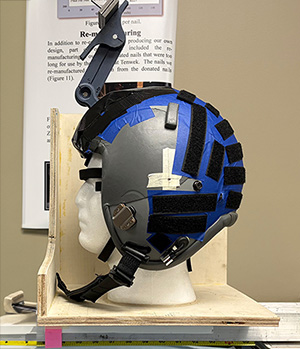
Payne, a mechanical engineering major with a minor in biomedical engineering, is researching solutions to reduce the long-term neck strain caused by front-loaded helmet systems worn by U.S. Air Force personnel. His work addresses a growing human-performance challenge in aviation and space operations, where helmet-mounted equipment can place significant stress on the cervical spine during extended missions.
Aerospace engineering innovation meets military aviation needs
The global space economy is experiencing unprecedented growth, driven by opportunities in satellite technology, commercial spaceflight and space tourism led by companies like SpaceX, Blue Origin and Rocket Lab. Rather than waiting until graduation to contribute to this expanding industry, Payne is developing technology designed to support the next generation of aerospace professionals.
The work is part of a multi-year senior design project within the School of Engineering and Computer Science, with each student team building on previous research and prototypes. While earlier design teams worked directly with personnel at Wright-Patterson Air Force Base, the current project collaborates primarily with subcontractors affiliated with the base, providing real-world insight into helmet ergonomics and military aviation.
“The goal is to reduce that strain on pilots’ necks,” said Payne. “We can reduce it by modifying the helmet so that there’s more weight in the back, balancing the forward moment.”
 How biomechanical engineering can reduce pilot neck strain
Payne’s project focuses on customizing airmen’s helmets using anthropomorphic modeling and biomechanical analysis to better distribute weight and reduce cervical spine compression. To explore how customization can be implemented, Payne is measuring neck force and helmet weight while evaluating engineering solutions designed to improve pilot comfort, operational endurance and career longevity.
Ohio Space Grant Consortium supports undergraduate aerospace research
Payne’s research is funded by the Ohio Space Grant Consortium (OSGC), a federally sponsored scholarship program funded through NASA’s STEM education division. The consortium equips undergraduate students with hands-on research experience, strengthening the national pipeline of students pursuing careers in science, technology, engineering and mathematics. Through the support, Payne has received mentorship, research funding and opportunities to present his work to the professional engineering community.
“The research project has given me a real look at what it means to do work beyond just a homework problem or a lab assignment,” said Payne. “It’s been a great chance to explore the intersection between the human body and technology and to do work that tangibly helps people.”
Cedarville engineering student connects research with service
For Payne, the project is more than just numbers in a formula; it has a lasting impact for the personnel who operate high-performance aircraft every day.
“One thing I’ve learned at Cedarville is to remember the ‘why,’” said Payne. “It’s not ultimately about the numbers you put on the page but how those numbers can be used to love and serve others.”
Student research presentations expand aerospace engineering impact
Payne hopes to continue refining his research during his senior year with the long-term goal of contributing to aerospace biomedical innovation. He presented his research at the Biomechanical Engineering and Anthropometry Meeting on March 24, 2026, and will share at the Ohio Space Grant Consortium Annual Student Research Symposium on April 10, 2026, providing opportunities for professional feedback from researchers and industry leaders.
Human-centered engineering shapes the future of flight
As commercial spaceflight and advanced military aviation continue to evolve, research like Payne’s highlights the growing importance of human-centered engineering, ensuring that technological progress is matched by innovations that safeguard the health and performance of those who make flight possible.
About Cedarville University
Cedarville University, an evangelical Christian institution in southwest Ohio, offers undergraduate and graduate residential and online programs across arts, sciences and professional fields. With 7,265 students, it is among Ohio's largest private universities and is ranked among the nation’s top five evangelical universities in the Wall Street Journal’s 2026 Best Colleges in the U.S. Cedarville is also known for its vibrant Christian community, challenging academics and high graduation and retention rates. Learn more at cedarville.edu.