






by Cara Ramer, Student Public Relations Writer
As artificial intelligence (AI) becomes increasingly common in homes and classrooms, the question is not whether children will interact with it, but who is shaping those systems, with what values and for what purpose.
The Role of AI in Christian Education
Many parents and educators are concerned about generalized AI use among students as they develop academic skills, form values and shape their worldviews. Some may lean toward avoiding AI entirely — but for Martyn Iles, preacher, commentator and former leader at Answers in Genesis, AI presents a unique educational opportunity.
Introducing Proto: A Faith-Based AI Learning Platform
 Iles envisions an AI-integrated educational system that is ideologically sound, academically rigorous and highly customizable. This idea led to the birth of Proto, a Christian education platform that leverages AI to deliver personalized, accountable learning for families and educators.
“It is increasingly difficult for parents to find education solutions for their families that are both academically superb and ideologically safe,” said Iles. “The program really started with a question: How do you combine academic excellence and ideological accountability in a single education model that’s accessible to everyone?”
How AI Personalizes Curriculum in Proto
Proto will operate from a single master curriculum, translating its content into age-appropriate learning materials. When fully operational, the platform is expected to create specialized outputs like syllabi, lesson plans, assessments and other educational resources that can be customized for individual learners and instructional settings. While Proto is primarily designed for home-educating families, it will have be applicable to traditional classrooms, churches and educational communities worldwide.
“Proto is meant to support education rather than replace it,” said Iles.
Cedarville University Students Power Early AI Development
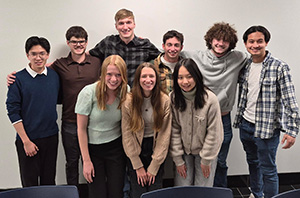 Although the project remains in its early stages, Cedarville University computer science students have played a key role in its research and development. A five-member senior design team provided critical early contributions, helping shape foundational decisions related to the program’s AI models. The team includes senior computer science majors Lydia Bingamon of Roanoke, Indiana, and Linnea Albright of Savage, Minnesota; Eli Payton, a senior cyber operations major from Williamston, Michigan; junior Matthew Dudley, a double major in cyber operations and computer science from Plainfield, Illinois, and sophomore Joshua Hochstedler, a cyber operations major from São Paulo, Brazil.
Since the project’s launch, four additional junior students have joined the effort: Myles Young, a double major in cyber operations and computer science from Marysville, Ohio; Micah Crowe, a double major in cyber operations and computer science from Maywood, Illinois; Doreen Yin, a computer science major from Guangzhou, China and Caleb Cao, a computer science major from Beijing, China.
Future of AI in Education: Immersive and Interactive Learning
Iles said partnering with Cedarville students allowed the team to test the project’s feasibility, refine the project through hands-on development and invest in equipping future leaders to work faithfully in advanced technology.
“We’re grateful to be working with Cedarville, and the project team has genuinely added a lot to what we’re doing,” said Iles.
As the program continues to progress, Iles hopes to expand Proto’s capacity for interactive learning. “AI can construct virtual, immersive worlds that students can learn in,” he said. “You could be learning about the American Revolution or Moses crossing the Red Sea and observe events happening in a particular time and place. Our long-term goal is to increase interactivity, engagement and historical understanding in learning.”
As AI continues to shape how students learn and interact with information, Proto represents a model where emerging technologies support education without replacing human guidance or conviction.
About Cedarville University
Cedarville University, an evangelical Christian institution in southwest Ohio, offers undergraduate and graduate residential and online programs across arts, sciences and professional fields. With 7,265 students, it is among Ohio's largest private universities and is ranked among the nation’s top five evangelical universities in the Wall Street Journal’s 2026 Best Colleges in the U.S. Cedarville is also known for its vibrant Christian community, challenging academics and high graduation and retention rates. Learn more at cedarville.edu.