








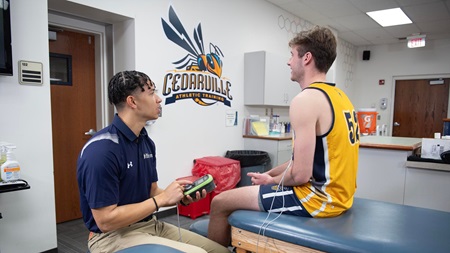
You love sports, movement, and healthcare — but you’re not sure which career path is right for you. Two of the most common options are athletic training (AT) and physical therapy (PT). Both careers play vital roles in sports medicine, yet they differ in focus, education, and career settings.
Understanding these differences is an important first step in making your decision. Let’s begin by defining each profession.
Defining the Professions
What Is Athletic Training?
According to the National Athletic Trainers’ Association (NATA), an athletic trainer is:
“a highly qualified, multi-skilled health care professional who renders service or treatment under the direction of or in collaboration with a physician, in accordance with their education, training, and the state's statutes, rules, and regulations. As part of the health care team, services provided by athletic trainers include primary care, injury and illness prevention, wellness promotion and education, emergent care, examination and clinical diagnosis, therapeutic intervention, and rehabilitation of injuries and medical conditions.”
What Is Physical Therapy?
The American Physical Therapy Association (APTA) defines a physical therapist as:
“a licensed doctor who works with multiple patient populations impacted by disease, injury, and movement dysfunction. They optimize quality of life by maintaining, restoring, and improving patients’ ability to move, function, and live more active lifestyles.”
Athletic Trainer vs. Physical Therapist: Key Differences
Athletic trainers primarily work with athletic populations — including athletes, first responders, military personnel, performing artists, and industrial workers — to prevent, assess, and treat acute injuries.
Physical therapists, on the other hand, work with a variety of patient populations to guide them through rehabilitation after injury, surgery, or during chronic conditions.
A key difference in patient care is that athletic trainers often see patients before injury, at the time of injury, and throughout recovery, while physical therapists typically see patients after injury through the return to functional activity.
Education Requirements and Degree Pathways
Both professions require a graduate degree, but the degree types and timelines differ.
- Athletic Training: Requires a master’s degree.
- Physical Therapy: Requires a doctoral degree.
Entry into either program requires a completed undergraduate degree and the necessary prerequisite courses.
How Long It Takes
Beyond the four-year undergraduate degree:
- The Master of Athletic Training (MAT) is typically a two-year program.
- The Doctor of Physical Therapy (DPT) is typically a three-year program.
Cedarville University offers an accelerated BS in sport medicine + MAT option, allowing you to complete both an undergraduate and master’s degree in just five years!
AT vs. PT: At a Glance Comparison Chart
| Athletic Training | Physical Therapy | |
|---|---|---|
| Focus | injury prevention, immediate/acute care, therapeutic intervention | injury rehabilitation and long-term recovery |
| Degree | Master’s | Doctorate |
| Total length of schooling | approximately six years | approximately seven years |
| Settings | colleges/universities, secondary schools, professional sports, non-traditional settings | outpatient clinics, hospitals, rehab centers |
| Environment | fast-paced, varied settings, full scope of patient care | structured rehab settings with diverse patient populations |
Both professions are in high demand. According to the U.S. Bureau of Labor Statistics, athletic training and physical therapy are each projected to grow 11% from 2024 to 2034.
Cedarville University’s Athletic Training and Pre-Physical Therapy Options
If athletic training sounds like a good fit, Cedarville University offers an accelerated 3+2 program, allowing students to complete both a Bachelor of Science in sport medicine (three years) and the Master of Athletic Training (two years) degrees in just five years.
Students interested in physical therapy typically pursue a Bachelor of Science in allied health or exercise science with a pre-physical therapy track. Cedarville does not currently offer a graduate DPT program.
FAQs About Athletic Training and Physical Therapy Careers
Do I have to work with all populations as a physical therapist, or can I only work with athletes?
Physical therapists often serve all populations but may occasionally work with athletes. To specialize in athletic care, you’ll need to pursue employment in sports-specific or orthopedic settings.
Will I only work with athletes if I become an athletic trainer?
Not necessarily. The AT profession has expanded into diverse areas, including the armed forces, occupational health, performing arts, physician practices, public safety, and healthcare administration. Traditional settings still include secondary schools, colleges/universities, and professional sports.
Do both AT and PT require a graduate degree?
Yes. PT requires a clinical doctorate, while AT requires a master’s degree.
How do salaries of ATs and PTs compare?
Athletic training vs. physical therapy salary and job outlook according to the Bureau of Labor Statistics (2024):
- Athletic Trainers: $60,250 per year (average)
- Physical Therapists: $101,020 per year (average)
Salary varies by setting, years of experience, and additional credentials.
Can I be both an AT and PT?
Yes, but it’s becoming less common. To practice both, you must complete both graduate programs and pass the respective national board exams.
Find Your Path in Healthcare at Cedarville University
If you’re ready to be on the front lines of injury prevention or rehabilitation, athletic training or physical therapy may be the perfect fit! Cedarville University has a number of professional healthcare degree programs to help you meet your goals and set you on the path to a successful career.
Posted in Healthcare