







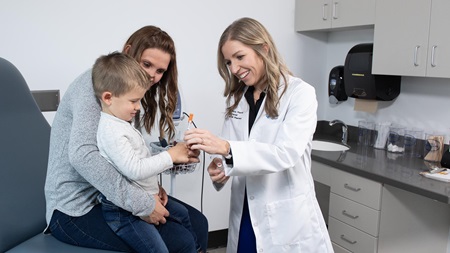
If you enjoy science and love helping people, pharmacy could be the perfect career path for you. Pharmacists are trusted healthcare professionals who combine medical knowledge with personal care — ensuring medications are safe, effective, and used correctly.
As Thad Franz, PharmD, explains: “Pharmacists are the medication experts. They play a huge role in keeping patients safe and helping them understand their treatments.”
Whether you’re a high school student just starting to explore healthcare or a college junior considering graduate school, understanding the path from a bachelor’s degree to a PharmD will help you see how this career could fit your strengths and calling.
Why Choose Pharmacy?
Pharmacy is one of the few careers that blends science, service, and leadership every single day. Pharmacists do more than fill prescriptions. They also educate patients and collaborate with physicians every day to prevent medication errors and save lives.
“Pharmacists are the most accessible healthcare professionals,” says Dr. Franz. “You don’t even need an appointment to talk to one. The pharmacist and pharmacy are a vital part of the health of the community they serve.”
The field is also evolving quickly. Once focused mainly on dispensing a product, today’s pharmacists are front-line clinicians who provide direct patient care, manage chronic conditions, and lead healthcare teams. “Healthcare is becoming more of a team effort,” Franz adds, “and pharmacists play a significant role on the healthcare team.”
What Is a PharmD?
A Doctor of Pharmacy (PharmD) is a professional doctoral degree required to become a licensed pharmacist. It builds on your undergraduate science foundation and prepares you for both clinical practice and research.
PharmD programs combine classroom instruction on the study of drugs (pharmacology) and how it applies to the body (therapeutics) with hands-on labs and clinical rotations. Most PharmD programs take about four years after a completed bachelor’s degree, though some universities offer six-year direct-entry programs that integrate undergraduate and professional studies.
Cedarville offers a six-year accelerated, direct-entry program that allows you to complete your bachelor and doctoral degrees as well as a Bible minor!
Who Is a Good Fit for Pharmacy School?
If you enjoy problem-solving, teamwork, and detailed science courses, you may thrive in pharmacy school.
Many students come from backgrounds in biology, chemistry, or molecular biology, but other science majors work too. Some schools even offer a prepharmacy undergraduate degree with an option for acceleration into a graduate degree program.
“We see a lot of students who start in chemistry or molecular biology because they love science and want to help people,” says Dr. Franz. “Pharmacy lets them do both.”
Successful pharmacy students are curious, disciplined, and compassionate — and they value precision and serving people.
Prerequisites and Admissions Basics
While requirements vary by program, most PharmD schools expect:
- General and organic chemistry
- Biology and microbiology
- Anatomy and physiology
- Calculus
- English composition and communication
You’ll strengthen your application by maintaining a competitive GPA, gaining shadowing or lab experience, and demonstrating leadership or service involvement.
While some programs still recommend the Pharmacy College Admission Test (PCAT), most (including Cedarville) no longer require it.
What To Expect in Pharmacy School
Your journey from BS to PharmD will start with advanced sciences and move quickly into real-world learning. You’ll study how medications interact with the body, learn to counsel patients, and practice in simulation labs before working directly with patients under the supervision of a preceptor in the field.
“About a third of the doctoral program is experiential learning,” explains Dr. Franz. “Students start working in pharmacy settings their first year — we want them to practice what they’re learning right away.”
By your final year, you’ll complete multiple clinical rotations in hospitals, clinics, and community pharmacies, exploring specialties such as cardiology, pediatrics, oncology, or geriatrics.
Career Paths With a PharmD
The career opportunities with a PharmD span more than 100 different roles. Roughly one-third of pharmacy graduates enter community practice, while another 35–40% complete residencies to pursue specialized clinical roles. Others build careers in research, industry, healthcare administration, and leadership.
Depending on your interests, you might be drawn to pharmacy jobs in:
- Healthcare policy
- Healthcare leadership
- Innovation
- Medical research
- Military service
- Patient care
- Sports medicine
"Pharmacy really lets you combine science, service, and leadership," Dr. Franz highlights. "You're impacting lives every day."
Example: A Christ-Centered Approach to Pharmacy Education
For some students, pharmacy is more than a career — it’s a calling to serve. At Cedarville University, that calling is central to the Doctor of Pharmacy program.
“All of our faculty, staff, and students have made a profession of faith,” explains Dr. Franz. “Our faculty model what it means to live out their faith in the classroom and in practice.”
Faith integration at Cedarville shows up in patient care discussions, ethics coursework, and even lab work. “In our palliative care course, we talk about compassionate treatment, suffering, and the sanctity of life,” he says. “We want students to think biblically about caring for patients long before they’re in those positions as practitioners.”
That same integration extends to clinical experiences. Students often serve in hospitals, community clinics, and global missions settings, applying their skills while sharing Christ’s love. “Our students have prayed with patients in the ER and ICU,” Franz shares. “They’re bold in their witness, and that stands out.”
Inside the Cedarville Experience
Cedarville’s PharmD combines rigorous academics with hands-on learning and personal mentorship. “If you asked any of our faculty why they chose to work at Cedarville,” Dr. Franz reflected, “they’d tell you they’re here for the students — to teach pharmacy and to mentor them both professionally and spiritually.”
The small, supportive community sets Cedarville apart. With class sizes averaging 35–45 students, faculty invest deeply in each student’s success. “We call it our pharmily,” Franz says. “We want to know their story and help them reach the finish line together.”
Cedarville graduates also excel after graduation, boasting an 80% residency match rate (well above the national average) and consistently strong NAPLEX licensure pass rates. Students seeking career versatility can pursue dual-degree options, such as the PharmD + MBA or PharmD + MA in Strategic Innovation, preparing them for leadership in healthcare.
Is Pharmacy Right for You?
Pharmacy might be the perfect fit if you:
- Love science and problem-solving
- Enjoy helping and teaching others
- Want a healthcare career with stability and flexibility
- Feel called to serve through medicine
Dr. Franz’s advice: “Shadow a pharmacist — not just in a drugstore but in a hospital or clinic. The more you see, the clearer your calling will become.”
The Bottom Line
Pharmacy is a dynamic, respected profession that connects scientific discovery with compassionate care. A PharmD degree builds on your bachelor’s foundation and opens doors to meaningful, well-paying, and versatile careers.
If you’re passionate about people and precision — and want to make a difference in healthcare — pharmacy might just be where your future begins.
Interested in exploring programs that blend excellence with purpose? Learn more about Cedarville University’s School of Pharmacy, where students prepare to serve Christ and their communities through patient-centered care.
Posted in Healthcare