







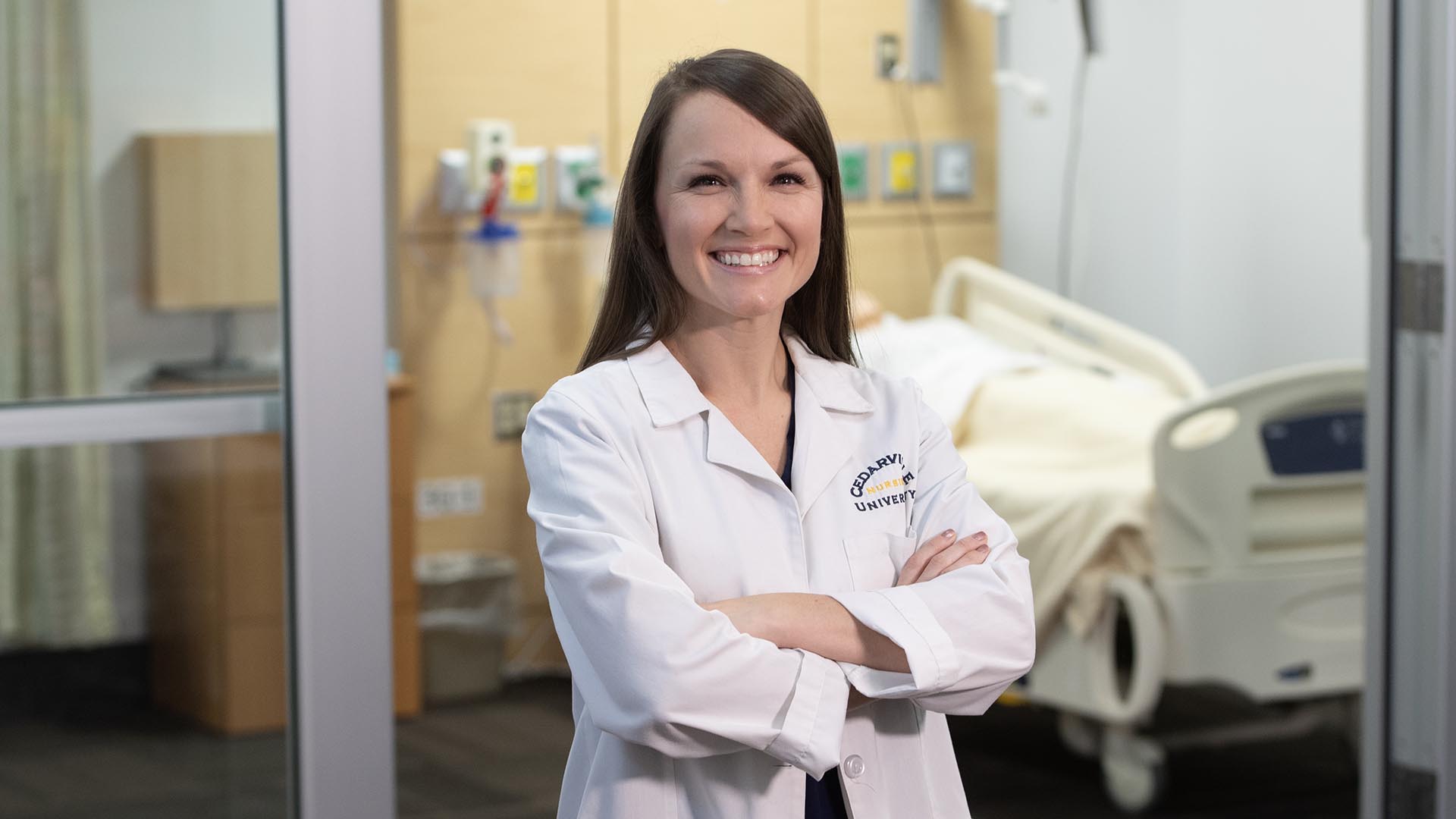
If you’re considering a future in healthcare, you’re exploring a field centered on service, responsibility, and care for others. From direct patient care to leadership and community health, healthcare careers offer a wide range of paths shaped by both professional skill and personal values.
Use the buttons below to explore healthcare careers and degree pathways, understand the education and training required for each role, and learn how faith-integrated preparation at Cedarville University shapes professional practice, leadership, and patient care.
Explore Healthcare Careers
Healthcare careers span hospitals, clinics, laboratories, schools, nonprofit organizations, and community settings. Whether you’re drawn to hands-on patient care, scientific research, leadership, or community service, healthcare offers a wide range of roles that align with different strengths, interests, and callings.
Consider the various healthcare careers below and discover the degree pathways to get there.
Patient Care and Clinical Practice
direct patient care, nursing, physician assistant, clinical health roles
ExploreRehabilitation and Performance Care
physical therapy, athletic training, rehabilitation sciences, sports medicine
ExploreMental and Behavioral Health
mental health counseling, psychology, behavioral health, therapy pathways
ExplorePharmaceutical and Medication Sciences
pharmacy, pharmaceutical sciences, medication management, patient safety
ExploreHealthcare Leadership and Administration
healthcare administration, leadership, management, health systems
ExploreResearch and Health Innovation
clinical research, health sciences research, medical innovation, data analysis
ExplorePre-Professional Health Pathways
medical school preparation, dental, PA, optometry, professional health programs
ExploreIs a Healthcare Career the Right Fit for You?
If you’re thinking about healthcare, you probably want a career that feels meaningful. You may enjoy science, problem-solving, or working with people — or you may simply know you want to help others in practical, real-world ways.
Healthcare offers a wide range of paths, and healthcare careers are in demand. Some students are drawn to hands-on patient care, while others are interested in leadership, research, education, or improving community health.
Whether you picture yourself working in a clinic, hospital, school, lab, or community setting, healthcare careers allow you to combine skill, responsibility, and service in meaningful ways.
What Does It Take to Become a Healthcare Professional?
Healthcare careers don’t all follow the same path — and you don’t have to have everything figured out right now.
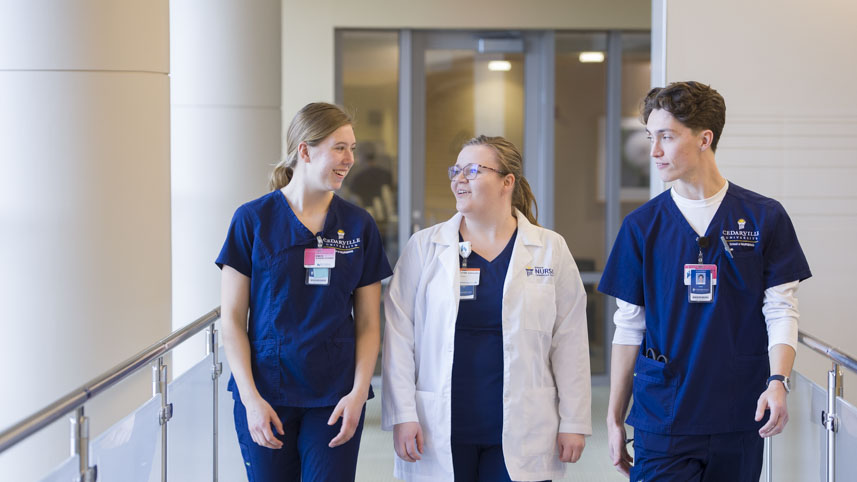
Some healthcare roles begin with undergraduate degrees, while others require graduate or professional education, clinical training, or licensure. Careers that involve direct patient care — such as pharmacy, athletic training, nursing, or physician assistant roles — often include hands-on clinical experiences as part of the educational process.
Many students start college by building a strong foundation in science and general education courses, then narrow their focus as they gain experience, confidence, and guidance.
How Does Faith Fit Into Healthcare Education at Cedarville?
At Cedarville University, students prepare for healthcare careers within an evangelical Christian learning community that connects faith with real-world practice. Rather than separating belief from profession, a biblical worldview shapes how students think through ethical decisions, interact with patients and colleagues, and respond to the responsibilities that come with caring for others.
Students are challenged to see healthcare not just as a career but as a way to serve. Alongside developing strong clinical skills, they grow in character, integrity, and leadership — qualities that prepare them to serve well in a wide range of healthcare settings.
Compare Healthcare Pathways and Programs
These expert-written articles take a closer look at specific healthcare programs, helping students understand curriculum, clinical experiences, and career outcomes.
How an MSN + MBA Dual Degree Prepares You to Lead in Healthcare
In healthcare today, registered nurses (RNs) do more than just provide clinical care. They are also leading diverse teams and managing challenging budgets in complex healthcare systems that impact the well-being of thousands of patients
The healthcare landscape is rapidly evolving with new technologies, changing regulations, and an aging population. These shifts require nursing leaders to possess advanced clinical and administrative skills.
According to the Bureau of Labor Statistics’ Employment Projections 2022–2032, the RN workforce is anticipated to grow from 3.1 million in 2022 to 3.3 million in 2032 — which means the demand for nursing leaders who combine clinical knowledge with business insight will continue to increase.
How Advanced Degrees Prepare You for Leadership
As the healthcare environment changes, nurses are being called upon to serve in leadership roles that require both clinical expertise and administrative understanding. Nurse leaders must be able to manage teams, budgets, and organizational change while ensuring high-quality patient outcomes.
Across the nation, healthcare organizations increasingly value leaders who can bridge clinical and business perspectives — professionals who are mission-driven, ethically grounded, and prepared to navigate complex healthcare systems.
This growing demand highlights the importance of advanced education that prepares nurses for leadership — education that unites the art of caring with the science of management. Programs that combine nursing and business training help equip nurse leaders to guide teams, improve systems, and drive positive patient outcomes in a rapidly changing environment.
What Is an MSN + MBA Dual Degree?
A dual graduate degree that unites a Master of Science in Nursing (MSN) and a Master of Business Administration (MBA) equips Bachelor of Science in Nursing (BSN)-prepared RNs with both advanced clinical nursing expertise and business leadership skills. This combination prepares nurses for professional roles in administration, healthcare management, and policy development.
In many dual-degree pathways, nurses can study online or through flexible formats, completing both programs concurrently. Integrating business coursework and advanced nursing study helps future nurse leaders gain well-rounded knowledge of the key business aspects of healthcare, including finance, organizational strategy, and operational management.
Why an MSN + MBA Is in Demand
Earning an MSN + MBA equips nurses to meet today’s healthcare demands through a unified approach to clinical and organizational leadership. This combined program of study reflects a national emphasis on interdisciplinary leadership — preparing nurse executives who can balance patient-centered care with organizational sustainability and strategic growth.
Such MBAs for nurses often integrate leadership principles — including ethical and servant-leadership models — with practical management training to help RNs advance their education without stepping away from their calling to care. Graduates are prepared to lead with both compassion and competence across a variety of healthcare settings.
Career and Leadership Benefits for Nurses
Obtaining a dual MSN + MBA degree allows RNs to expand their career opportunities into roles such as chief nursing officer, director of nursing, or other healthcare executive positions.
There is also increased earning potential, leadership mobility, and ability to influence healthcare policy, quality, and patient outcomes.
Some dual-degree programs, like the online MSN + MBA dual degree at Cedarville University, also emphasize values-based or faith-informed leadership, allowing students to develop servant-leadership skills rooted in moral and ethical principles.
Inside Cedarville’s MSN + MBA Program
For nurses seeking a Christ-centered approach to this dual-degree path, Cedarville University offers an MSN + MBA degree program that combines advanced nursing education with business and leadership development.
The integration of coursework from both nursing and business allows for shared leadership outcomes such as organizational management, strategic planning, and ethical decision-making. Graduates are equipped to enter complex healthcare environments and lead with both competence and integrity.
Flexible Online Format and Completion Options
Cedarville’s graduate nursing programs are offered fully online, providing flexibility for working professionals. Students are supported and mentored by faculty experienced in both advanced nursing and business disciplines.
The average time to complete the online MSN + MBA dual degree at Cedarville University depends on whether students enroll full time or part time. On average, completion of the program takes about three years, though timelines may range from two to six years.
Is the MSN + MBA Right for You?
The MSN + MBA dual degree is ideal for BSN-prepared RNs pursuing administrative or leadership roles, such as nurse managers seeking formal business education alongside advanced nursing leadership knowledge.
It also fits nursing professionals passionate about improving healthcare systems to support positive patient outcomes while maintaining organizational sustainability.
At Cedarville University, this dual degree especially appeals to those drawn to Christ-centered leadership and the integration of faith and vocation in healthcare.
FAQs: Your Questions Answered
What can I do with an MSN + MBA dual degree?
This program equips you with the business and leadership skills needed for management and high-level administration roles within healthcare, such as clinical administrator, chief nursing officer, director of nursing, executive manager, or hospital administrator.
How long does it take to complete an MSN + MBA dual-degree program?
On average, completion takes about three years, though it can range from two to six years depending on enrollment.
Can I work while pursuing an MSN + MBA dual degree?
Yes, most students continue working while completing their coursework, often adjusting their schedules to balance professional and academic responsibilities.
Can I get an MSN + MBA dual degree online?
Yes, Cedarville’s MSN + MBA dual degree is offered fully online.
Lead With Confidence and Compassion
By combining the disciplines of nursing and business, the MSN + MBA dual degree empowers nurses to become visionary leaders who serve with both compassion and competence.
At Cedarville University, this program provides flexibility, mentorship, and faith integration to help nurses lead effectively in any healthcare environment.
Posted in Healthcare



Healthcare Blog Contributors
Cedarville University's healthcare blog articles are written by faculty and professionals with real-world and academic expertise.
Melissa Burns, MD
Associate Professor of Biology
Ken Blood, EdD, ATC
Master of Athletic Training Program Director, Professor of Athletic Training
Thad Franz, PharmD
Associate Dean for Student Affairs, PharmD Program Director, Professor of Pharmacy Practice
Jason Grahame, MPA, PA-C, DFAAPA
PA Program Director, Associate Professor of PA Studies
Mary Smith, PhD, DNP, FNP-BC, FAANP
Adjunct Instructor of Graduate Nursing Programs