







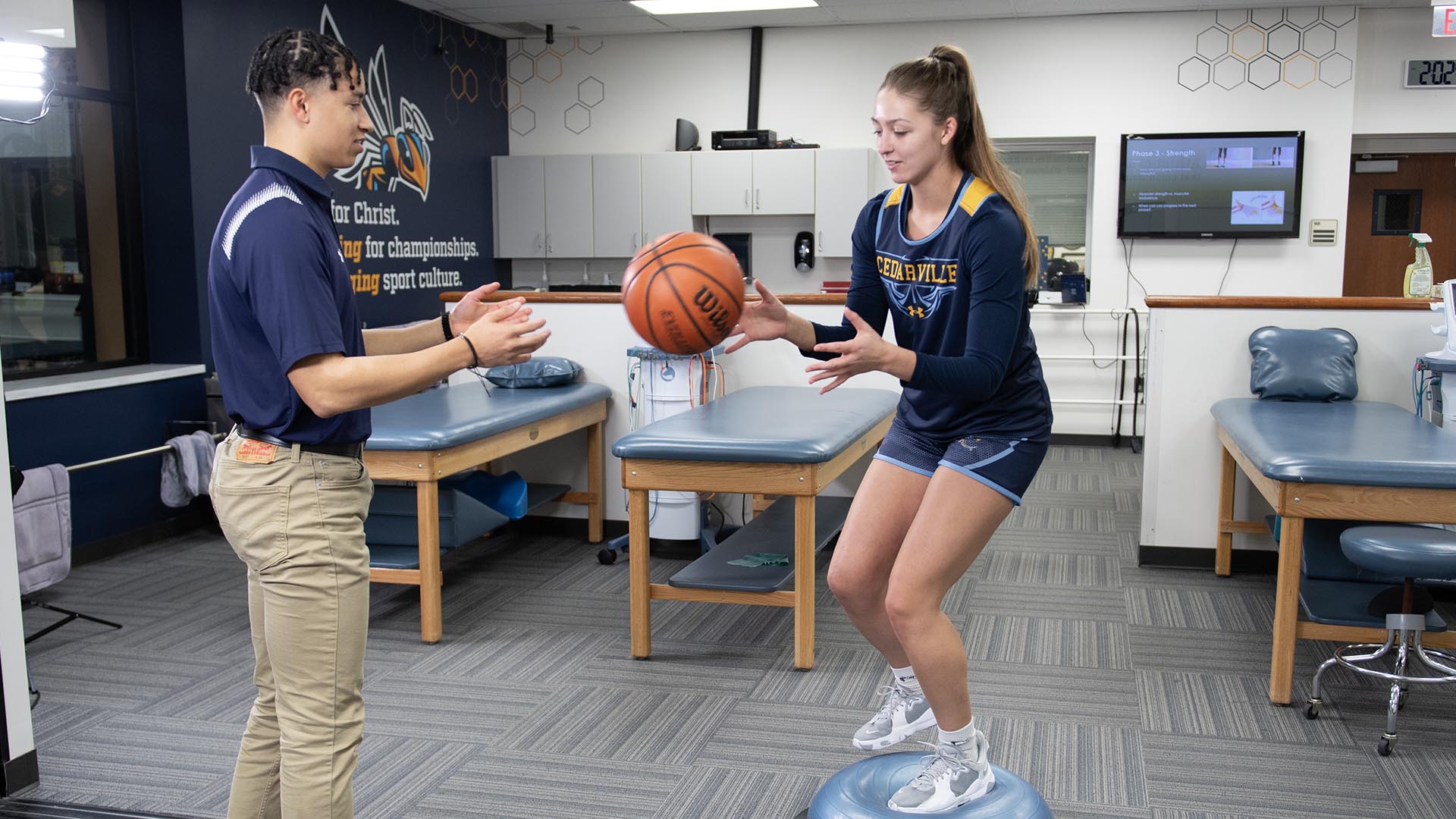
If you’re considering a future in healthcare, you’re exploring a field centered on service, responsibility, and care for others. From direct patient care to leadership and community health, healthcare careers offer a wide range of paths shaped by both professional skill and personal values.
Use the buttons below to explore healthcare careers and degree pathways, understand the education and training required for each role, and learn how faith-integrated preparation at Cedarville University shapes professional practice, leadership, and patient care.
Explore Healthcare Careers
Healthcare careers span hospitals, clinics, laboratories, schools, nonprofit organizations, and community settings. Whether you’re drawn to hands-on patient care, scientific research, leadership, or community service, healthcare offers a wide range of roles that align with different strengths, interests, and callings.
Consider the various healthcare careers below and discover the degree pathways to get there.
Patient Care and Clinical Practice
direct patient care, nursing, physician assistant, clinical health roles
ExploreRehabilitation and Performance Care
physical therapy, athletic training, rehabilitation sciences, sports medicine
ExploreMental and Behavioral Health
mental health counseling, psychology, behavioral health, therapy pathways
ExplorePharmaceutical and Medication Sciences
pharmacy, pharmaceutical sciences, medication management, patient safety
ExploreHealthcare Leadership and Administration
healthcare administration, leadership, management, health systems
ExploreResearch and Health Innovation
clinical research, health sciences research, medical innovation, data analysis
ExplorePre-Professional Health Pathways
medical school preparation, dental, PA, optometry, professional health programs
ExploreIs a Healthcare Career the Right Fit for You?
If you’re thinking about healthcare, you probably want a career that feels meaningful. You may enjoy science, problem-solving, or working with people — or you may simply know you want to help others in practical, real-world ways.
Healthcare offers a wide range of paths, and healthcare careers are in demand. Some students are drawn to hands-on patient care, while others are interested in leadership, research, education, or improving community health.
Whether you picture yourself working in a clinic, hospital, school, lab, or community setting, healthcare careers allow you to combine skill, responsibility, and service in meaningful ways.
What Does It Take to Become a Healthcare Professional?
Healthcare careers don’t all follow the same path — and you don’t have to have everything figured out right now.
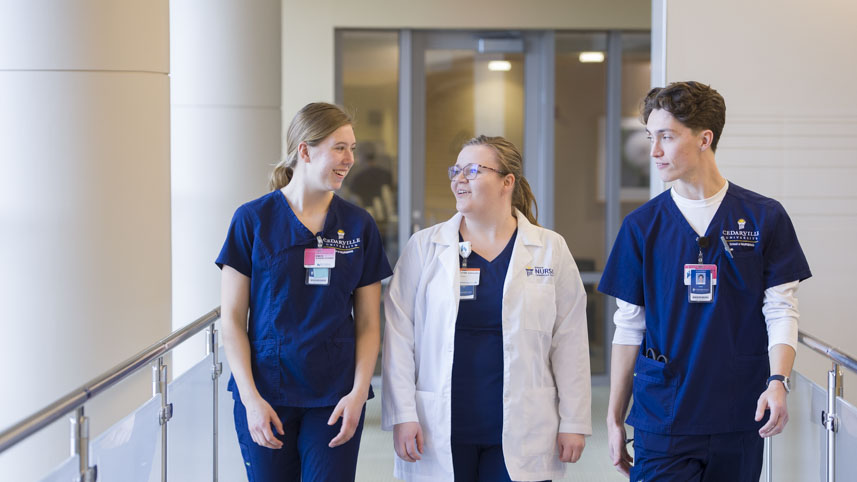
Some healthcare roles begin with undergraduate degrees, while others require graduate or professional education, clinical training, or licensure. Careers that involve direct patient care — such as pharmacy, athletic training, nursing, or physician assistant roles — often include hands-on clinical experiences as part of the educational process.
Many students start college by building a strong foundation in science and general education courses, then narrow their focus as they gain experience, confidence, and guidance.
How Does Faith Fit Into Healthcare Education at Cedarville?
At Cedarville University, students prepare for healthcare careers within an evangelical Christian learning community that connects faith with real-world practice. Rather than separating belief from profession, a biblical worldview shapes how students think through ethical decisions, interact with patients and colleagues, and respond to the responsibilities that come with caring for others.
Students are challenged to see healthcare not just as a career but as a way to serve. Alongside developing strong clinical skills, they grow in character, integrity, and leadership — qualities that prepare them to serve well in a wide range of healthcare settings.
Compare Healthcare Pathways and Programs
These expert-written articles take a closer look at specific healthcare programs, helping students understand curriculum, clinical experiences, and career outcomes.
From BS to MAT: How to Become an Athletic Trainer
If you love the idea of helping athletes perform at their best and bounce back from injury, athletic training might be the perfect fit
So what’s the next step from your bachelor’s degree to a rewarding healthcare career? Here’s what you need to know about becoming a certified athletic trainer and how to prepare for the next step in your education.
What Does an Athletic Trainer Do?
Athletic trainers (ATs) are healthcare professionals who collaborate with physicians to provide preventive services, emergency care, clinical diagnosis, therapeutic intervention, and rehabilitation of injuries and medical conditions.
Athletic trainers work in a variety of settings, from high schools and universities to clinics, hospitals, and professional sports teams. They’re often the first healthcare provider on the scene when an injury occurs and the last to ensure a full recovery.
In other words, athletic trainers are the behind-the-scenes healthcare professionals making sure athletes stay healthy, recover well, and return to doing what they love.
How To Become an Athletic Trainer
To become a certified athletic trainer, you’ll need to graduate from a CAATE-accredited professional program. If you already hold or are finishing your bachelor’s degree, you’re in the perfect place to take that next step!
Since 2022, a master’s degree has been required for entry into the field — most commonly a Master of Athletic Training (MAT) or Master of Science in Athletic Training (MSAT).
Note: Cedarville University has a fully accredited MAT program!
If you’re looking to specialize or advance even further, you can pursue residencies, fellowships, or doctoral programs in areas like rehabilitation, orthopedics, or sports performance.
Today, about 70% of athletic trainers hold at least a master’s degree, showing how the profession continues to grow in both education and expertise.
How To Prepare for Your MAT or MSAT
- Take prerequisite courses including anatomy and physiology (two semesters with a lab), biology, chemistry, physics (all with labs), exercise physiology, and emergency care (including first aid/CPR).
- Gain relevant experience through shadowing athletic trainers.
- Maintain a strong GPA and build relationships with mentors who can provide recommendations.
Note: Cedarville offers a 3+2 BS in sport medicine + Master of Athletic Training (MAT) program that allows you to complete your prerequisites and master's degree in just five years!
What To Expect in an CAATE-Accredited Professional Program
MAT and MSAT programs prepare students for both the exam and for their transition to professional practice, emphasizing clinical reasoning, communication, and patient-centered care.
A quality program combines rigorous academic coursework with a variety of clinical experiences. Students can expect:
- Foundational courses in injury evaluation, therapeutic modalities, emergency care, and rehabilitation. Skills courses teach and refine necessary hands-on skills.
- Clinical education experiences with diverse patient populations — ranging from high school and collegiate athletics to professional teams and emerging healthcare settings.
- Evidence-based practice and research components that prepare students to make data-informed clinical decisions. At Cedarville University, you will also complete a thesis.
- Interprofessional learning, where you’ll collaborate with physicians and other healthcare professionals.
Programs typically take two years to complete, blending classroom learning with hands-on application in real-world environments. Yes, it’s challenging — but you’ll be learning side-by-side with professionals, treating real patients, and building confidence every step of the way.
Upon completion of a CAATE-accredited MAT or MSAT program, graduates become eligible to sit for the Board of Certification (BOC) exam — the national credential required to practice as an athletic trainer. After certification, ATs must also meet state licensure requirements which vary by location.
Admissions and Timeline
Ready to apply? At Cedarville, cohorts begin each June, and the application process is straightforward.
Prospective students apply using the Athletic Training Centralized Application System (ATCAS). A separate, brief Cedarville application is also required. Applicants provide transcripts and letters of recommendation and complete an interview.
Applications are reviewed on a rolling basis from the time ATCAS opens until the course start date. To ensure your place in the program, we recommend submitting your application by March 1. The program takes 23 months to complete at Cedarville.
FAQ Section
1. I already have a bachelor’s degree — do I qualify for the MAT or MSAT?
Yes! If you have completed a bachelor’s degree (in any discipline) and meet the program prerequisites, you are eligible to apply for the MAT or MSAT. Many students enter from various undergraduate backgrounds before pursuing athletic training at the graduate level.
2. What if my undergraduate major isn’t in exercise science or sports medicine?
That’s okay. While many students come from health science backgrounds, it’s not required. What matters is that you have completed (or plan to complete) the required prerequisite coursework. Many students take the required undergraduate science, math, and other courses at a local community college, university, or through online programs.
3. How long does it take to complete the MAT or MSAT?
Most MAT and MSAT programs are two years (five to six semesters) in length, typically including summer coursework. The structure allows students to progress through academic learning, clinical rotations, and research in a sequential, integrated way.
4. What career settings can I work in after earning an MAT or MSAT?
Athletic trainers are in demand across a wide range of professional settings, including:
- Colleges and universities
- Secondary schools and club sports programs
- Sports medicine and orthopedic clinics
- Hospitals and physician practices
- Industrial, corporate, and military health settings
- Performing arts organizations
The flexibility of the degree opens doors to both traditional and emerging healthcare roles.
5. How does Cedarville’s MAT integrate faith with healthcare training?
At Cedarville University, the MAT program is built upon a foundation of biblical worldview integration.
Students are equipped with not only advanced clinical knowledge and skills but also a commitment to serving patients with compassion, integrity, and Christ-centered care.
Faculty model faith-informed professionalism and challenge students to see athletic training as both a vocation and ministry.
Get Started on Your Athletic Training Journey
Your bachelor’s degree built the foundation. Now it’s time to take the next step — earn your MAT at Cedarville University and prepare to serve others through skilled, Christ-centered care.
Posted in Healthcare



Healthcare Blog Contributors
Cedarville University's healthcare blog articles are written by faculty and professionals with real-world and academic expertise.
Melissa Burns, MD
Associate Professor of Biology
Ken Blood, EdD, ATC
Master of Athletic Training Program Director, Professor of Athletic Training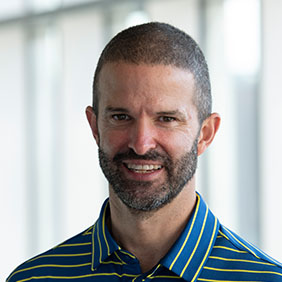
Thad Franz, PharmD
Associate Dean for Student Affairs, PharmD Program Director, Professor of Pharmacy Practice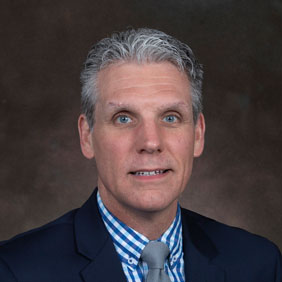
Jason Grahame, MPA, PA-C, DFAAPA
PA Program Director, Associate Professor of PA Studies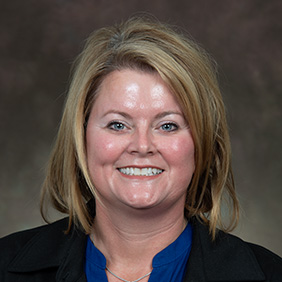
Mary Smith, PhD, DNP, FNP-BC, FAANP
Adjunct Instructor of Graduate Nursing Programs